
I Had Knee Surgery, Now What?
Whether you’ve had an ACL or MPFL reconstruction, meniscus repair, or a more complicated multi-ligament procedure, recovery doesn’t end when you leave the operating room. The days and weeks following surgery are just as important in the healing process, and knowing what to expect can help you feel more confident and prepared.
At Banff Sport Medicine, our team is here to support you through every phase of your recovery from injury – getting you back to the activities you enjoy.
The First Few Days: Recovery & Pain Management
After knee surgery, it’s normal to experience pain, swelling, stiffness, fatigue, as well as numbness or a change of sensation when touching your skin.

Image: Midwestind.com
It’s also normal that your recovery is not perfectly linear. Think of recovery like an uphill gravel road: your overall trajectory is upward, with slight bumps, including peaks and valleys along the way. Your knee won’t feel the same from day to day. The following 2-3 days after surgery are typically the most painful.
If you can effectively manage your pain levels in the early days, you will find it easier to move your knee, perform your exercises, sleep better and weight bear as directed by your surgeon. The goal of pain management is not to eliminate pain entirely, but to keep it at a tolerable level. Waiting until pain becomes severe can make recovery more difficult.
Learn more about Managing Your Pain After Surgery on our Resource Page.
In addition to the medications and cold therapy, the Reparel Leg Sleeve recommended by your surgeon as part of your post-surgical equipment can also help with pain management. As soon as 5 days post-surgery, it’s recommended to sleep in your leg sleeve to support your body’s natural recovery process to promote circulation and help move inflammation out of the knee.
These three tools in combination – medication, cold therapy, leg sleeve – can help reduce your pain to a tolerable level.
Why Early Movement Matters
Many patients are surprised to learn that rehabilitation begins almost immediately after surgery.
The research shows that early movement positively impacts recovery by:
- improving circulation and reducing swelling
- restoring knee range of motion
- preventing stiffness within the joint which reduces the risk of complications
- beginning the process of rebuilding muscle strength
In addition to following the exercises prescribed by your surgeon in your rehabilitation protocol, 10 days post-surgery is typically a good time to start formal physiotherapy.
A physiotherapist can ensure you are using proper techniques when completing your exercises. They can also tailor exercises to your specific needs and recovery. Your physio can also identify challenges you might have to overcome, such as helping your quadriceps muscles to “wake up”….more on that below!
Understanding Arthrogenic Muscle Inhibition (AMI)
After surgery, it’s common for your quadriceps muscles to have trouble working correctly, especially the vastus medialis oblique (VMO). This happens because the original injury, surgery, and pain and swelling around the knee can disrupt the normal communication between your brain and the muscle that helps straighten and stabilize your knee.
This temporary problem is called arthrogenic muscle inhibition, or AMI.
Learn more here about AMI and why it can happen
What does AMI feel like?
Almost everyone experiences some degree of AMI after knee surgery, but the severity and how long it lasts can vary.
You may notice:
- you can’t fully straighten your knee despite consistently working on your extension exercises
- your quadriceps feel like they won’t contract, even when you try
- your knee bends rather than straightens when you try to tighten your quadriceps
- hamstring muscles that feel unusually tight or “ropey”
- your knee remains swollen and painful
Persistent swelling, higher levels of pain, and more complex injuries or surgeries can increase the risk of AMI.
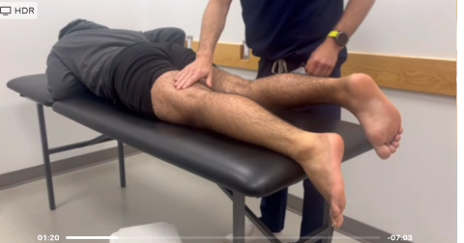
Why is it important to address AMI?
In many cases, AMI improves with consistency in doing the prescribed exercises and using an Electrical Muscle Stimulation (EMS) machine.
However, when it persists, it can make recovery more difficult.
Ongoing AMI can contribute to:
- loss of knee extension and the ability to fully straighten your knee
- difficulty walking or using stairs
- ongoing knee pain
- differences in muscle strength between your two legs
- a longer rehabilitation and return-to-sport timeline
- an increased risk of another injury
Early rehabilitation is an important part of overcoming AMI.
If you have any symptoms of AMI, it’s important to address them as soon as possible. Consult with your surgeon or physiotherapist so they can assess what’s going on and determine the right approach for your recovery!
Recovery takes time!
Just like every patient is different, so is your recovery!
Your recovery time depends on many factors, including how your body reacts to the injury and surgery, the specific procedure you had, your overall health, and rehabilitation goals.
As the initial healing phase passes, rehabilitation becomes more focused on improving knee stability, strength, endurance, proprioception and eventually transitioning into more sport/activity specific exercises like jumping and hopping, changing directions, and managing impact.
After a typical knee ligament surgery, you can expect at least a full year dedicated to regaining strength and allowing the ligament to fully heal before it is safe to return to sport.
Your surgeon and healthcare team will direct you through the recovery process ensuring you are meeting the milestones required to safely return to activity, as this timeline varies from surgery to surgery and patient to patient.
